2800–2200 BC
The Corded Ware battle axe
2800–2200 BCEvidence of agriculture and livestock farming
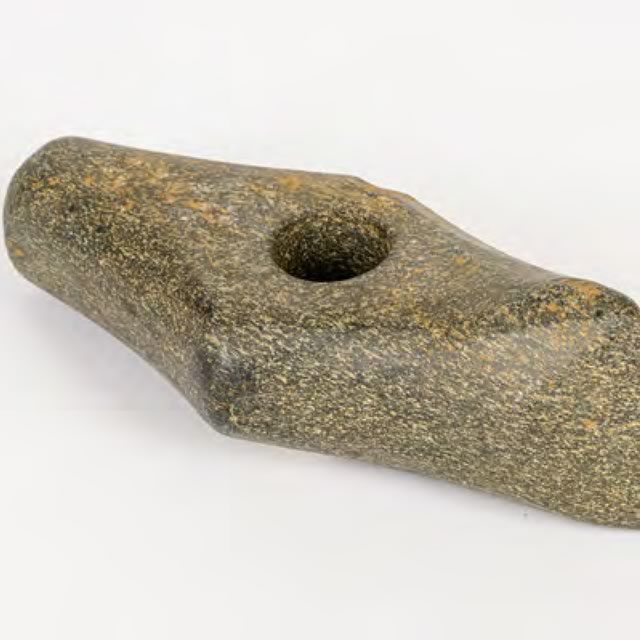
We go 4,200 to 4,800 years into the past with the Corded Ware battle axe exhibited here, which is made of light gray to greenish rock. The length measures 13.5 cm, while the width of the cutting edge is 4.4 cm. The perforation is slightly conical at 2.2 to 2.0 cm. Particularly striking are the beautifully faceted side surfaces and the bifacially ground, finely polished, metallically gleaming upper side.
The Corded Ware culture extended over an area from Alsace in the west, Switzerland in the south, Ukraine in the east, up to Norway in the north, and gets its name from its typical corded pottery. This was created by pressing cords into the clay before it was smoothed.
In addition to the typical burial method (single burial in a lateral position with drawn-up legs under burial mounds, men always lying on their right side, women always on their left), it was the grave goods – beakers and/or amphorae and the eponymous stone-crafted battle axe – that lead scientists to speak of “Beaker or Battle Axe cultures” during the Copper Age, at the transition from the Neolithic to the Bronze Age.
Meanwhile, science assumes that the Corded Ware people – like other Neolithic cultures – were sedentary and practiced agriculture and animal husbandry.
This unique piece, which is extraordinary for our museum, was found during the construction of the autobahn in the 1930s near Alsfeld at the Rabenberg. (MNic)