2026
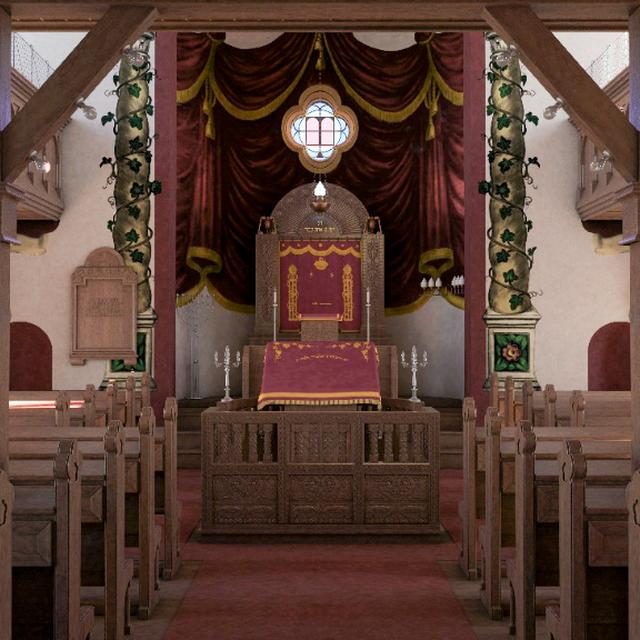
The interior of the Alsfeld synagogue according to the digital model.
2026The Virtual Reconstruction of the Alsfeld Synagogue
The Alsfeld Synagogue, designed by the architect Fritz Adam, was built in 1904/1905 on Lutherstraße and ceremoniously inaugurated on Friday, December 29, 1905. During the November Pogroms of 1938, the synagogue was set on fire and demolished, with the exception of an outbuilding.
Some objects were saved and are preserved today by the History and Museum Association Alsfeld—including the Torah ark, a clock cabinet, and an embroidered cover that lay on the bimah (reader’s desk). All of these objects were integrated into the virtual reconstruction in various ways.
The computer reconstruction is also based on extensive source material. Dimensioned floor plans, section and elevation drawings, as well as a perspective interior sketch from 1903 provided a good overview of the synagogue and its dimensions. However, the plans must be viewed critically, as they are only design drawings. When compared with historical photographs, minor differences from the synagogue as actually built become apparent. Nevertheless, the floor plans provided an impression of what the areas of the synagogue that are not visible in the surviving photos might have looked like.
The surviving photographs show the east, south, and west sides of the synagogue. From the interior, only photos showing the east wall with the Torah ark exist.
For the reconstruction of the remainder of the space, design plans had to be consulted. All these sources were supplemented by a building description by the architect, newspaper articles, and eyewitness accounts, which provided important information on color schemes and materials.
Despite the relatively extensive source material, some areas remained unclear; these were plausibly supplemented as part of the virtual reconstruction or modeled after comparable synagogues.
The above-mentioned surviving interior objects served in various ways to create virtual objects. Photographs of the Torah ark, which is stored in separate parts in the museum’s depot, provided an excellent basis for recreating it on the computer.
The decorations and color of the bimah cover could be recreated using photographs. The color was also used for the Torah curtain and the cover of the cantor’s desk.
The digital model of the clock cabinet, on the other hand, was created using an automated process (SfM) based on approximately 100 systematically taken photographs, which was then further refined so that existing cracks could be retouched.