2006
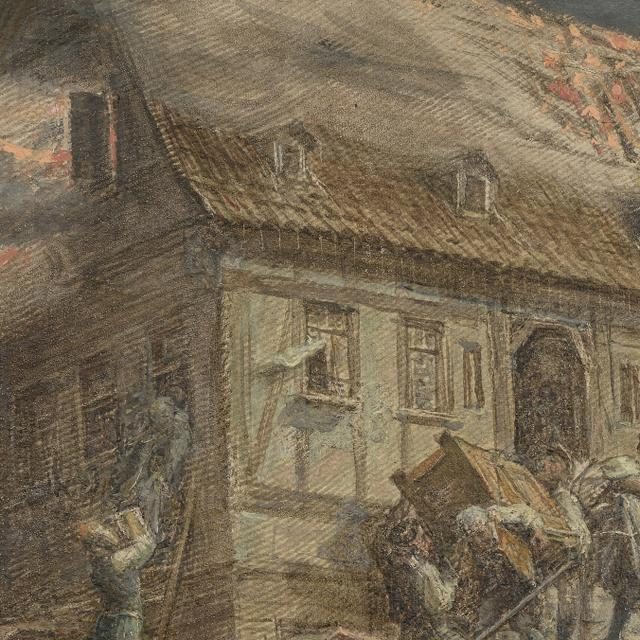
Johann Heinrich Hasselhorst (1825–1904): Fire in Hattendorf
2006Looted Art! Exactly 20 Years Ago, the Painting by Johann Heinrich Hasselhorst Was Acquired
Johann Heinrich Hasselhorst (1825–1904) was among the painters who frequently visited the Schwalm region, finding motifs for their paintings and drawings there. Hasselhorst did not have far to travel to the Schwalm: from 1860 to 1895, he was a very popular drawing teacher at the art school in Frankfurt’s Städel Institute. Appointed professor in 1888, he trained numerous young artists and accompanied them on field trips, including to the Schwalm. He preferred painting genre scenes. The painting “Fire in Hattendorf” (“Brand in Hattendorf”) was not sold by the artist during his lifetime, but entered the hands of his daughter, Auguste Scheuer-Hasselhorst, in Frankfurt as part of his estate. She gradually sold her father’s paintings, particularly during the 1930s.
In 2006/2007, this painting became central to the affair involving former Mayor Herbert Diestelmann in Alsfeld. In 2006, Diestelmann acquired six paintings and a communion flagon for a total of approximately €168,700 from an art dealer—without consulting the responsible municipal bodies of the town of Alsfeld. As it turned out, the prices paid for the paintings were vastly inflated. He withdrew the purchase amount from the estate of Ilse Riechers (1910–2005), a former senior teacher (Oberstudienrätin) at the agricultural school in Alsfeld. She had bequeathed her fortune in equal halves to both the town of Alsfeld and the regional association of the German Red Cross in Alsfeld. The town’s share was intended to be used for local heritage preservation and the promotion of customs.
However, the transfer of the town’s share into the municipal budget took place only 21 months after her death, following the magistrate’s resolution on the supplementary budget ordinance on December 13, 2006. In the meantime, Mayor Diestelmann had already unilaterally disposed of the inheritance share, acquiring the communion flagon and the six paintings from the art trade in 2005/2006. In the process, several invoices and checks were shuffled back and forth between the art dealer and the mayor. Once this became public knowledge, a political scandal erupted in Alsfeld, leading to the mayor’s vote-out in May 2007.
The bitter irony of the story: this painting is “looted art” (Raubkunst). During the National Socialist era, it belonged to the persecuted Jewish collector Julius Rosenberg.
Julius Rosenberg (1870–1942) was a manufacturer in Frankfurt. Unmarried and childless, he lived with his sister Rika (1862–1942). Rosenberg was a partner in the firm Naxos Schleifwarenfabrik Burkard & Co. in Frankfurt, which manufactured grinding wheels. The company had been founded in 1888 by his father and the non-Jewish manufacturer Burkard. In 1920, both founders passed their shares on to their children. The Jewish and non-Jewish shareholders each held a 50% stake in the company.
In April 1938, the German Labour Front (Deutsche Arbeitsfront), an organization of the NSDAP, forcibly appointed a provisional administrator to initiate the sale of the Jewish owners’ share. The Naxos company was “Aryanized” on August 17, 1938—meaning it was forcibly sold to non-Jewish businessmen—and the share was sold for 110,000 RM. This was a giveaway price, given that the company alone had generated an annual turnover of 728,000 Reichsmarks in 1938. The Jewish entrepreneurs received nothing from the proceeds of the sale.
On November 16, 1938, a freeze order (Sicherungsanordnung) was issued against Julius Rosenberg and his sister Rika. This meant that the siblings could no longer freely dispose of their assets, as their entire wealth was frozen.
A few days later, Julius was forced to submit a so-called “valuation list” (Taxationsliste) for his art collection, which has been preserved to this day in the Main State Archives in Wiesbaden (Hauptstaatsarchiv Wiesbaden). These valuation lists were demanded by the tax authorities to gain an overview of Jewish assets and to prepare the planned expropriation through bureaucratic channels.
On his list, Julius listed the oil painting “Fire in Hattendorf” by Hasselhorst with an estimated value of 80 RM. Furthermore, the document shows that he owned additional paintings by Hasselhorst, all of which remain missing to this day.
Based on his 1938 asset declaration, the tax office in Frankfurt levied the discriminatory Jewish Capital Tax (Judenvermögensabgabe) amounting to 25% of his total assets. To make matters worse, the Rosenberg siblings also had to fear deportation. Rika consequently took her own life on July 1, 1942, at the age of 80. Forced by circumstances, Julius moved into a smaller apartment on August 3, 1942, following his sister’s death.
On September 1, 1942, at the age of 72, Julius Rosenberg was deported by the Gestapo to Theresienstadt and murdered there on October 2, 1942. The remainder of his assets was confiscated in favor of the German Reich on October 8, 1942.
Starting in July 1942, elderly Jewish individuals were forced to sign a so-called “home purchase contract” (Heimeinkaufsvertrag) for accommodation in the Theresienstadt concentration camp, for which they had to yield between 25% and 80% of their assets depending on their age. In doing so, accommodation in a supposed home for the elderly was falsely represented to them. In reality, however, they were plundered by the Gestapo and tax officials at the assembly points even prior to deportation. Jewelry, cash assets, and house keys were taken from them. While still in the assembly camp prior to deportation, they received formal notice that their assets would be confiscated without exception by the German Reich.
The majority of elderly people died after just a few weeks in Theresienstadt from malnutrition, unhygienic conditions, cold, and disease.
Julius Rosenberg’s nephews, Jakob-Paul Rosenberg (1903–1971) and Karl Ferdinand Rosenberg (b. December 20, 1904), managed to flee to Great Britain in 1937, where they acquired British citizenship and founded an abrasives factory in Padiham, Lancaster, that same year together with their uncle Louis Rosenberg.
After 1945, the nephews initiated indemnification proceedings (Wiedergutmachungsverfahren). In the proceedings, they testified that Julius Rosenberg had sold his art collection during his lifetime, but the proceeds had been deposited entirely into a frozen account (Sperrkonto). As proof, the nephews submitted photos from Julius Rosenberg’s apartment to the court, demonstrating the value of his home furnishings. Unfortunately, the Hasselhorst painting cannot be identified in them. However, the photo itself stands as a testament to emigration: it is torn vertically and creased horizontally. How was the photo transported to England? Who knows…
Not a single painting from this collection was recovered or returned to the heirs after 1945.
Presumably, the painting “Fire in Hattendorf” never left Frankfurt. In the 1980s, it resurfaced in the Frankfurt art trade. It was publicly exhibited in the Historisches Museum Frankfurt in 1993 and at the Arabella Sheraton Congress Hotel in Frankfurt in 2000. In 2006, Mayor Diestelmann acquired it from the art trade.
Following the mayor’s vote-out in 2007, the town of Alsfeld attempted in several lawsuits to reverse the purchase of the paintings. The purchase had been executed without the involvement of municipal bodies and at inflated prices. The painting “Fire in Hattendorf” had been acquired for €69,300, despite having a value of approximately €5,000. The case landed in court and ended in two settlements. The town of Alsfeld is now the owner of the painting and handed it over to the History and Museum Association (Geschichts- und Museumsverein) in 2007 as a permanent loan.