2000 BC
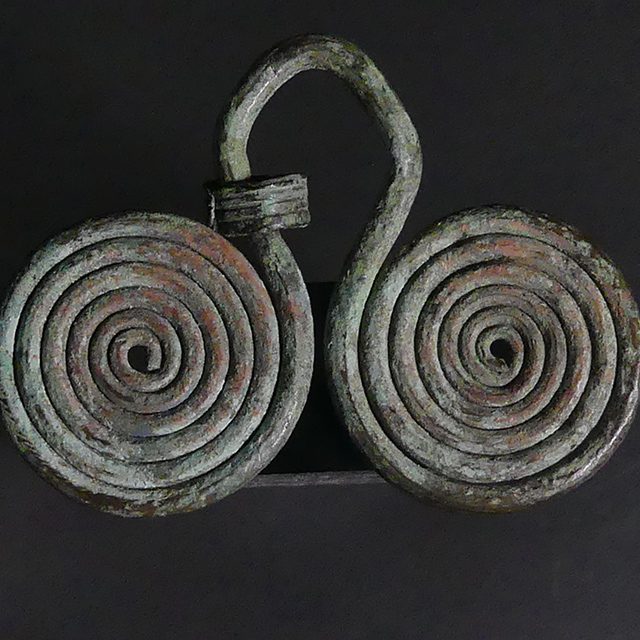
Double spiral pendant from a barrow near Alsfeld
Alsfeld populated!Beginning of Bronze Age settlement in the region
The exhibit on display here is a “double-spiral pendant,” also known as a “spectacle pendant,” from a burial mound in the vicinity of Alsfeld dating from the “Middle Bronze Age”. This period is also referred to as the “Tumulus culture” era (approx. 2200–800 BC in Central Europe) due to the burial rites practiced at the time. More than 250 burial mounds have been discovered and recorded in the Alsfeld district.
The possession of and knowledge about the production of bronze—an alloy consisting of 90% copper and 10% tin that can be cast into almost any shape and was the hardest metal known to date—led to social differentiation within society and the emergence of a new upper class. Since both metals occurred in only a few places—for example, tin in Cornwall, England, and copper in the Eastern Alps—this led to the development of trade routes and chains spanning the entire region from Europe to the Near East.
The grave goods were diverse; men were generally buried unburnt with their weapons, and women with abundant jewelry, and were then covered with fieldstones. Above this, a mound was formed, demarcated on the outside by a stone circle. (MNic)