1972

Herbert Arnold: Schwalm Veterans' Dance in Willingshausen, 1909
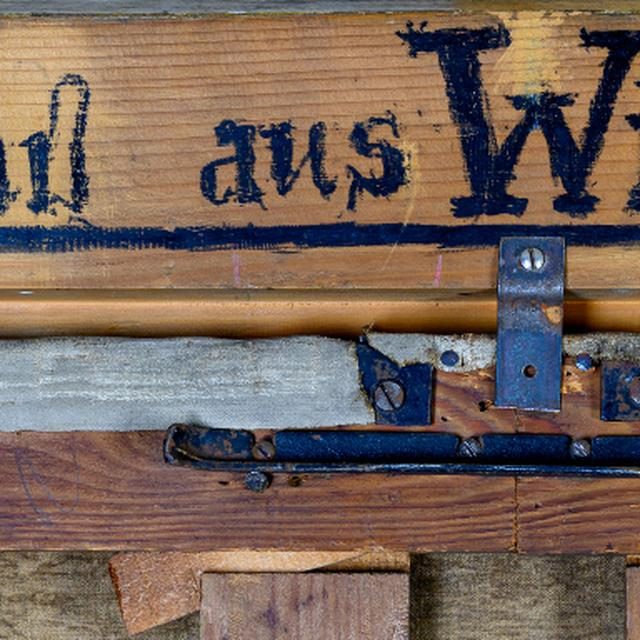
1972Greetings from Vienna
Due to these striking findings on the reverse side, the painting by Herbert Arnold was examined more closely.
The Berlin painter Herbert Arnold stayed in Willingshausen in the Schwalm region in February/March 1909. During this stay, he and the Berlin painter Franz Eichhorst witnessed the Veterans’ Dance, also known as the “Sausage Dance” (Wursttanz). He captured his impressions in this painting that same year.
On October 3, 1944, the “Veterans’ Dance” was auctioned at the Dorotheum auction house in Vienna and acquired for RM 6,000 by Karl Schwantner, an architect from Vienna. He kept the painting for over 25 years before selling it to the Alsfeld Museum in 1972 for DM 4,500. Before sending the painting to Alsfeld, he inscribed “19 Greetings from Vienna 72” (“19 Gruß aus Wien 72”) on the frame.
The fact that he acquired this painting at the Dorotheum in 1944 appears concerning.
The Dorotheum is a renowned auction house in Vienna. In the period following Austria’s so-called “Anschluss” (annexation) into the German Reich in March 1938, the Dorotheum profited significantly from the persecution of the Jewish population in Austria. It received artworks both directly from the persecuted, who were forced to sell them prior to their emigration, and from the state authorities of the German Reich. In 1940, the Gestapo in Vienna established the Property Disposal Office for Jewish Emigrants (Verwaltungsstelle für jüdisches Umzugsgut, or Vugesta). The Vugesta liquidated the so-called “removal goods” (Umzugsgüter) of approximately 5,000 Jewish families. Confiscated possessions, including artworks, furniture, jewelry, and other items, were auctioned through the Dorotheum. Since the “Veterans’ Dance” was offered at the Dorotheum in 1944, there is a suspicion that it may have originated from the property of persecuted Jews.
However, the provenance of the painting contains gaps that could not be closed even through current research. Ownership prior to 1944 could not be traced. Consequently, a sale forced by persecution or a confiscation between 1938 and 1944 can neither be ruled out nor confirmed. To date, no evidence has been found as to who consigned the painting to the auction house in 1944, and thus whether there are potential victims of looting. What remains is a suspicion.