1942
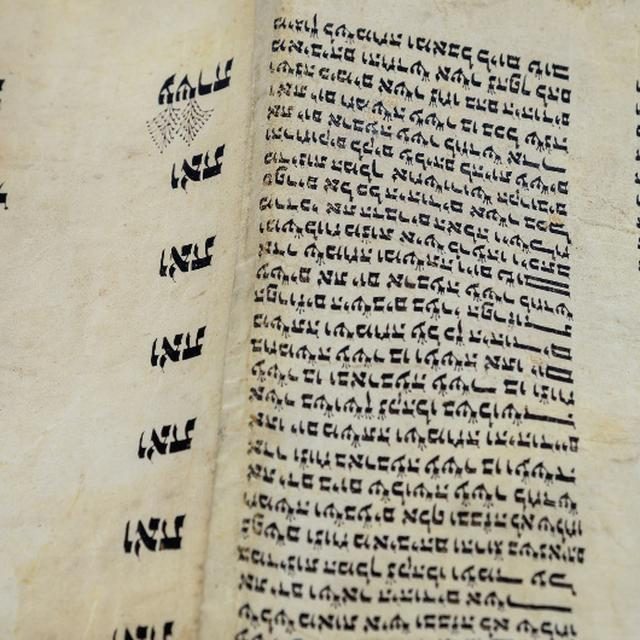

The Scroll of Esther from Ladyshyn (Ukraine).
1942Looted in Ukraine
The Scroll of Esther (Megillat Esther) tells the biblical story of the Jewish Queen Esther, who saved her people in Persia from total destruction. It is read aloud in the synagogue during Purim, a joyous Jewish festival.
This Esther scroll originates from Ladiczin (today: Ladyshyn), Western Ukraine. Lance Corporal (Gefreiter) Ludwig Karl Birkenstock (b. 1904) found the scroll outside the house of the shochet (ritual slaughterer) on a pile of other ritual objects and sent it from the front to Alsfeld. It arrived at the museum there in 1942 and was cataloged. Lacking knowledge of the Hebrew language, Birkenstock referred to the scroll as a “reconciliation poem” (Versöhnungsgedicht), stating that a “sky driver” (Himmelskutscher) had told him this. The term Himmelskutscher has several meanings: it was most commonly used to refer to pilots, but sometimes also to clergymen or hearse drivers.
The museum director, Rausch, repeatedly requested that Birkenstock report on his experiences at the front, thanking him in return with shipments of tobacco.
In 1939, the Jewish community in Ladyshyn numbered approximately 700 people. The town was occupied by the German Wehrmacht on July 24, 1941, which shot 486 Jews on September 13, 1941. Two days later, the area was occupied by Romania and incorporated into the administrative district (rayon) of the Transnistria region. Romania established a camp there for Jewish forced laborers from the surrounding area. However, none of these cruel events are mentioned in Birkenstock’s reports. His letters are held in the collection of the History and Museum Association (Geschichts- und Museumsverein).