1938
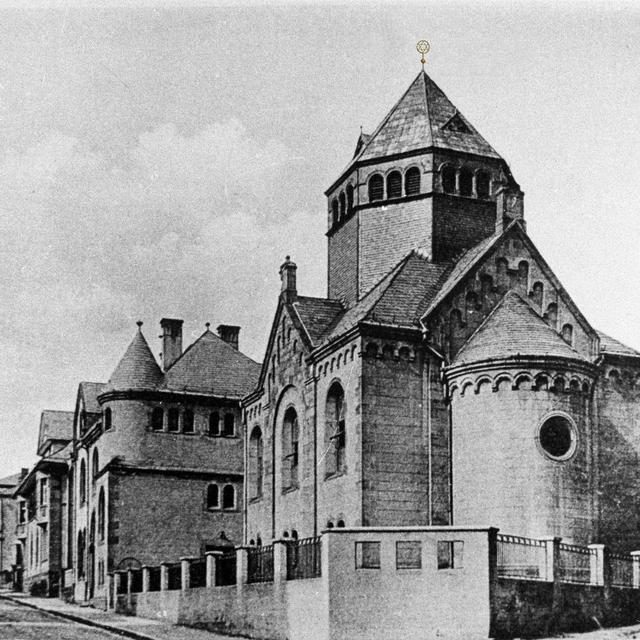
Model of the synagogue
1938Details on the Fire in the Synagogue, the Forced Sale, and the Liquidation
During the November Pogrom (Kristallnacht) on November 9, 1938, when the National Socialists acted with violence against Jewish people in the German Reich, the Alsfeld synagogue was set on fire after a fire was started inside the building at around 10:00 PM.
On this night, the SA man Hermann Trips played a decisive role, as he alerted the fire department via an anonymous tip. Although firefighting efforts were sabotaged, the fire department succeeded in extinguishing the flames. While the building’s leaded glass windows were smashed, apart from that, it appeared largely undamaged from the outside. The interior, however, was devastated and scorched; benches were smashed, and accessories and prayer books were torn to pieces. The furnishings of the synagogue caretaker’s apartment on the first floor were even completely destroyed.
Following this, the mob marched through the streets and attacked Jewish business owners. Two days later, 8 Jewish men between the ages of 18 and 65 were thrown into prison and transported by bus to the Klein-Buchenwald concentration camp, where they were locked up and mistreated for two weeks. Most of them were released shortly before Christmas. Among the victims was Philipp Moses, the last head of the Jewish community in Alsfeld.
Why did the SA man Hermann Trips prevent the further destruction of the synagogue on that night? He found himself in a conflict of interest. The synagogue had been built in 1905 with loans from the regional savings bank (Bezirkssparkasse), and in 1938 a mortgage amounting to 3,700 Reichsmark still burdened the property. As an SA man with anti-Semitic convictions, he welcomed the pogrom; as the director of the savings bank, however, he was interested in securing the mortgage. His interest lay solely in the building and the property, not in the inventory of the synagogue.
When Philipp Moses returned from the Buchenwald concentration camp at the end of 1938, Hermann Trips blackmailed him into signing over the synagogue to the savings bank. He threatened that there would be a “big fireworks display” on New Year’s Eve if he did not sign. Thus, on December 29, 1938, the properties of the Jewish community were forcibly transferred to the savings bank. These consisted of the property at Lutherstraße 1 (830 square meters) and a homestead at Blaupfütze 1 (237 square meters). The properties were transferred at a land value of 3,700 Reichsmark (RM), with the buildings not being valued at all. In return, the remaining loan debt was canceled. Even before the purchase agreement was approved by the competent authority, the savings bank had the main part of the synagogue demolished. The remaining part of the building, where the synagogue caretaker had lived, was converted into an apartment building. To this end, the savings bank invested approximately 35,000 RM, but generated rental income in subsequent years and utilized the demolition material from the synagogue. Wood and stones were partly used in the conversion of the apartment building and partly sold to the public. In early 1939, the remaining inventory of the synagogue was handed over to the History and Museum Association (Geschichts- und Museumsverein).
Philipp Moses left Alsfeld and was deported from Düsseldorf to Izbica on April 22, 1942. The exact date of his death is unknown, but he was declared dead in 1945.
His son Manfred Moses (1922–2010) managed to escape to Great Britain, where he changed his name to Michael Maynard. His memories of his youth in Hesse provide valuable insights into the everyday life of the Jewish population during the National Socialist era. Although he was not in Alsfeld at the time of the fire, he was arrested at the same time and met his father in the Buchenwald concentration camp, where his father described the events in Alsfeld to him. We thus have a second-hand account here, which nonetheless aligns with other contemporary witness reports.
The former chairman of the History and Museum Association, Heinrich Dittmar (1934–2014), made contact with Manfred Moses / Michael Maynard and corresponded with him between 2001 and 2002. Dittmar’s estate, which also contains this correspondence, is now located in the Hessian State Archive in Darmstadt.
As another contemporary witness, the museum director at the time, Karl Rausch (1879–1976), learned of the events on November 10, 1938, and hurried to the synagogue with an employee. Together, they succeeded in opening the Torah cabinet and recovering the ritual objects. They brought them to the museum in a basket and hid them there in an old oak chest dating from 1617. However, other items from the synagogue only reached the museum in the course of the demolition. On January 25, 1939, Karl Rausch received the clock cabinet, the Torah cabinet, the Torah scroll, two covers, and community books as a “donation” from the Alsfeld savings bank. In March 1940, the museum also received the Star of David from the roof of the synagogue from the savings bank.
After 1945, Rausch repeatedly told the story of the “rescue” of these objects. By contrast, the role of the Alsfeld savings bank in the forced sale and liquidation of the synagogue was concealed or glossed over.
In 1939, however, the museum almost lost a portion of the rescued items. According to a decree issued on February 21, 1939, Jewish owners were required to surrender objects made of gold, silver, or platinum to the responsible Municipal Loan Office (Städtische Darlehensanstalt) in Frankfurt. The aim of the action was to melt down precious metals for war purposes. The decree also applied to the Judaica in the Alsfeld museum. Among the ritual objects recovered by museum administrator Karl Rausch were items made of precious metals, which he was forced to surrender to the tax office in Alsfeld in the summer of 1939. Rausch handed over 18 silver ritual objects weighing 4.55 kg. The Municipal Loan Office evaluated precious metals solely according to their raw metal value, even if they were objects of significant cultural and historical value.
The surrendered objects from Alsfeld were thus evaluated at a material value of only 273 RM. Pointing out the non-profit status of the museum, Rausch succeeded that same year in saving these objects from being melted down and buying them back for the museum at a reduced price of 200 RM. The amount was raised through two donations, the donors of which, however, remain unknown. In addition, the museum received 6 sheet-metal ritual objects from the Municipal Loan Office that were worthless to the office.