1930
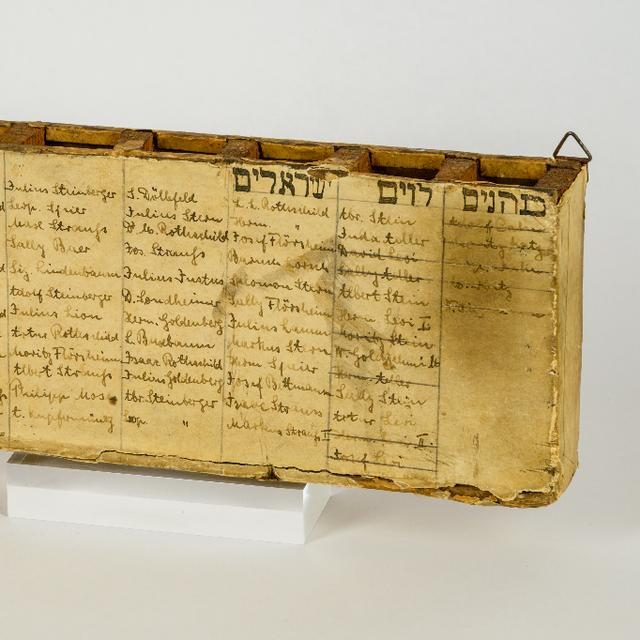

The synagogue box from the Alsfeld synagogue featuring the name lists of the Jewish community members.
1930The Synagogue Box as a Contemporary Witness
The box from the synagogue in Alsfeld is a rare artifact. No other box of this kind is known anywhere in Germany, neither in synagogues nor in public museums. In the Alsfeld synagogue, it presumably hung in the foyer. Its function can be deduced from the inscriptions.
Here we see a box with seven columns listing the names of numerous Jewish community members from Alsfeld. Since it was an Orthodox community, only men’s names are listed.
In Hebrew, text is read from right to left, and this list is structured in the same way. The top row features the Hebrew headings “Cohen” (1st column), “Levites” (2nd column), and “Israelites” (3rd–7th columns)—meaning the community members were divided into different groups based on their lineage. To keep track of who held which responsibilities, wooden sticks bearing the names of those present were likely placed in the box, and the corresponding individuals were then called upon.
The box clearly shows damage, whether from the fire or the water damage in November 1938. Age has also taken a toll on the ink over time, making many names illegible. Fortunately, the estate of Heinrich Dittmar (1934–2014) contained a photocopy of the box from the 1980s. More names were recognizable on that copy and could therefore be added to the name list in the display case. The fact that the list was maintained from right to left is also evident from the biographical data gathered for the names: reading from right to left, the listed Israelites become progressively younger.
At the same time, the box serves as an important contemporary witness, as the name list was maintained well into the 1930s. Struck-through names are also visible—these belong to individuals who moved away from Alsfeld in the 1930s or even emigrated from the German Reich altogether.
* Why were there different groups? The Cohen and the Levites had specific functions and privileges within Jewish ritual. The Kohanim (Cohen) descend from the priests of the Temple in Jerusalem; they are permitted to read from the Torah and recite a specific blessing. For this reason, blessing hands are frequently depicted on their gravestones. The Levites descend from the temple assistants in Jerusalem who aided the priests. Following the Kohanim, they hold the privilege of reading from the Torah. Their gravestones are often decorated with a Levite pitcher, as they poured water for the priests to wash their hands in the Jerusalem Temple. Gravestones featuring the symbol of blessing hands can still be found at the Jewish cemetery in Alsfeld today.