1928
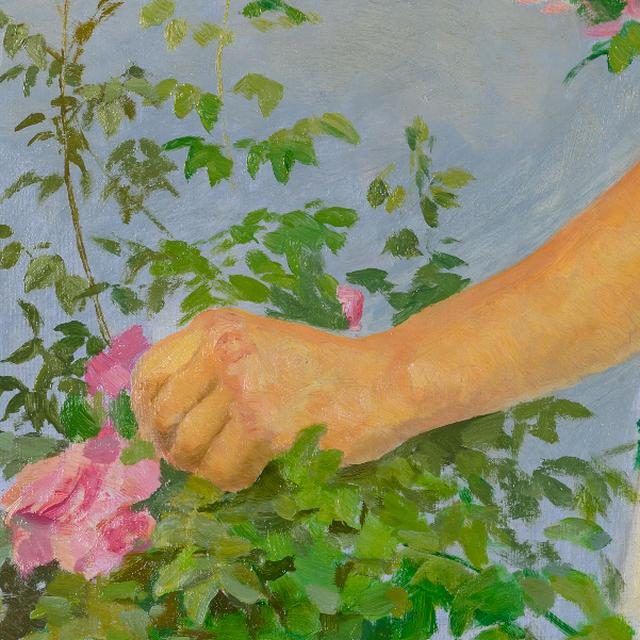

Carl Bantzer (1857-1941): Girl Picking Roses, signed and dated 1928.
1928A Young Lady’s Path
The origin of this painting was examined in more detail because there was an initial suspicion. The painting represents a study for a larger painting located in the town hall in Marburg. The Marburg painting is titled “The Path of Life”. It was commissioned in 1926 by the Marburg banking family Strauß. The Strauß family was of Jewish origin and was persecuted and expropriated during the National Socialist era. Therefore, it was suspected that this study had also been owned by the Strauß family. However, research revealed that the provenance of this painting is unproblematic.
The painter Carl Bantzer (1857-1941) belonged to those artists who, in the late 19th and early 20th centuries, discovered the landscape and people of the Schwalm region for themselves and depicted them in their works. He lived in Marburg from the 1920s onwards. Popular motifs included landscapes, portraits of Schwalm farmers, their traditional costumes, and festivals in the Schwalm. The works of Heinrich Hasselhorst and Herbert Arnold, which you can see in this room, also belong to this artistic movement.
The painting “The Course of Life” shows the different stages of life for men and women in their traditional roles at that time. “Girl Picking Roses” is located at the far right edge of the picture and shows a young girl looking at a rosebush, holding a rose in her hand as a symbol of (first) love.
“Girl Picking Roses” belonged to the Kassel banker Dr. Ludwig Pfeiffer (1881-1948), who was friends with Carl Bantzer. Bantzer was head of the Academy of Art in Kassel from 1918 to 1923 and met the banker there, even living with him at times. Pfeiffer also supported him and the academy financially during this period. Both men were founding members of the “Willingshäuser Malerstübchen” association, which served as a meeting place for visiting painters looking for motifs for their works in the Schwalm.
During the National Socialist era, Pfeiffer was considered an “undesirable person” for political reasons and had to resign from all his offices. During the Second World War, his art collection was relocated to Bad Wildungen starting in 1939/1940. There, 15 bunkers disguised as normal residential buildings had been built for the Air Force right in the city center. However, the Air Force never moved in. Instead, the bunkers were used to protect the population and secure art treasures from air raids. This painting was among the works that were relocated.
After Pfeiffer’s death in 1948, his son inherited the painting and left it on permanent loan to the Municipal Art Collection in Kassel from 1952 to 1980. Its holdings were merged with the State Art Collections Kassel in 1976. In 1980, the painting passed into private ownership in Marburg and was offered at an auction at Karl & Faber in Munich in May 1990 with an estimated value of 25,000–30,000 DM.
In 1995, the painting reappeared in the estate of Elisabeth Schulz in Alsfeld. The former teacher Elisabeth Schulz (1912-2006), residing at Goethestraße 14, collected Schwalm art and decided to bequeath her collection to the city of Alsfeld under the condition that after her death, the city of Alsfeld would build a “Schulz Museum” featuring Schwalm art in the Sackgasse alley. In return, she received two municipal plots of land. The magistrate of the city of Alsfeld gave its approval. Among the donated paintings was “Girl Picking Roses”.
After her death in 2006, Mayor Herbert Diestelmann had her house cleared and handed over this painting on loan to the Carl Bantzer Cooperative Comprehensive School in Schwalmstadt-Ziegenhain. However, the founding of the Schulz Museum never took place for several reasons: First, Herbert Diestelmann had to resign in 2007 and was charged with 15 counts of breach of trust in 2009; the handling of the Schulz estate played a significant role in this. Second, inheritance disputes arose with the two children and the Pommersches Landesmuseum Foundation in Greifswald, which had been appointed as heir. Third, the municipal budget had fallen into such distress that Alsfeld could no longer afford a new museum. In a settlement, the heirs and the city of Alsfeld agreed to waive mutual claims. The city of Alsfeld no longer had any interest in constructing the “Schulz Museum”. In 2010, the painting was handed over to the History and Museum Association as a permanent loan from the city of Alsfeld.