1765
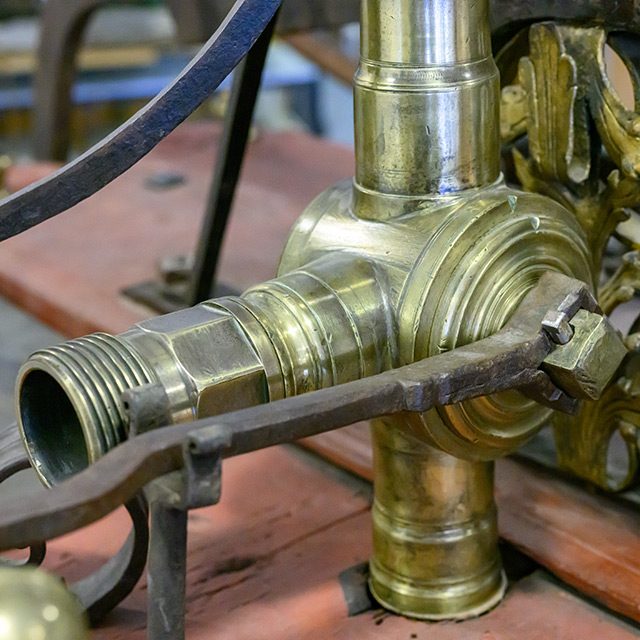

Fire engine of the city of Alsfeld from 1765.
(Photo: Andreas Ruhl)
1765Modern fire protection in Alsfeld
Fire protection was of vital importance in a city like Alsfeld, which consisted mainly of wooden buildings. In 1350, presumably after a major fire, the Liederbach stream was diverted and channeled through the city. This allowed extinguishing water to be brought to the scene of a fire more quickly. Leather fire buckets were used for this purpose. Long fire hooks were also essential; they were used to tear down walls and thus stop the spread of flames.
In 1764, Bailiff Hallwachs ordered two fire engines from the “fire engine maker” Johann Philipp Bach of Solms-Hungen for firefighting. The city council, together with all 16 guilds, refused to cover the costs. Nevertheless, the bailiff enforced payment – with the help of country hussars. In 1765, he also issued a fire protection ordinance with 25 paragraphs, which also regulated the operation of the engine. The 42 youngest citizens were obliged to operate the pump as “pushers.” As a reward after the extinguishing work, they received a “treat of bread, eggs, and brandy.”
The two fire engines were housed in the Hochzeitshaus, while fire ladders and hooks were kept in the Town Hall and the leather buckets in the Weinhaus. After the construction of water mains in 1896, hydrants became available throughout the city. The fire engine from 1765 was therefore moved to the museum. (JP)