1605
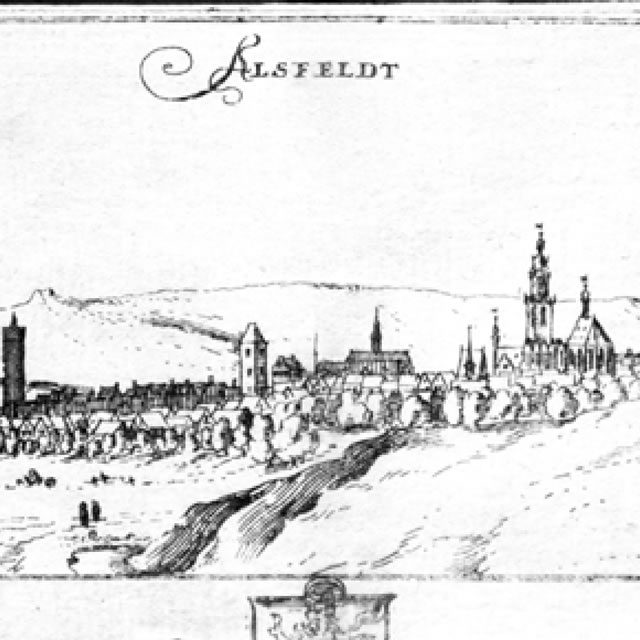
View of Alsfeld, copperplate engraving by Wilhelm Dilich from the year 1605
1605View of Alsfeld, copper engraving by Wilhelm Dilich
This copperplate engraving from 1605 is the second oldest surviving view of the city of Alsfeld, following Dilich’s drawing from 1591 (see this exhibition). Wilhelm Dilich was the son of the pastor Heinrich Scheffer, known as Dilich, from Wabern in Northern Hesse. Wilhelm attended the scholars’ school in Kassel and studied from 1589 to 1590 first at the University of Wittenberg, then from 1590 to 1591 at the Philipps University of Marburg. There he met the future Landgrave Moritz of Hesse-Kassel, for whom he worked from 1597 to 1622 as a landgravial draftsman and “Abreißer,” as well as a historian and master builder, “appointed as the official historiographus et geographus” of the Landgrave.
The copperplate engraving was included in the “Hessische Chronica” published in Kassel in 1605. Its first part contained the “Description and index of the nature of the land of Hesse,” provided with excellent pictorial decorations such as maps, city views, castles, palaces, and monasteries.
If one compares this copperplate engraving by Dilich with the much better-known and more famous engraving “Alsfeldt” by Matthäus Merian (the Elder) from his “Topographia Hassiae” (a major publishing achievement in a total of 30 volumes with 2142 individual views), which appeared 41 years later and is also shown in this exhibition, it quickly becomes clear who provided the template for the Merian engraving and where the expression “abkupfern” (to copper-bottom/copy) originates from. (MNic)